Full Reels vs Partial Reels: Document Remaining Footage
Classify each reel by whether the original seal is intact, the original footage is documented, and the remaining continuous length can be supported without cutting, stripping, or re-spooling the cable.
Send the reel label, package counts, remaining footage, condition, release, storage and access details for review. No purchase, price, timing or logistics outcome is guaranteed.
Show what supports a partial reel's continuous length
Original footage and remaining footage answer different questions. A tag identifies the package supplied; it does not account for later use. Record whether the reel is unopened, opened with supported full length, or partial with a known or unknown balance.
Keep the original tag and the balance in separate fields
Record the original label length, present reel condition and source of the remaining-length figure. Job-use logs or reel schedules help only if they refer to the same reel and reflect all withdrawals. An intact seal is useful evidence, but appearance alone cannot establish a quantity.
Use matching length marks only when the run is verified
Readable footage marks at both ends can support a difference when the unit, sequence and uninterrupted cable run are established. Record the readings and photographs. Do not combine different runs, assume an unmarked end is zero or infer continuity from a reel identifier alone.
Treat weight-based figures as a documented method, not a guess
Gross reel weight includes the reel and packaging. Converting it to cable length requires appropriate tare and verified mass-per-length data for the exact construction, with units and assumptions recorded. Without that evidence, report the measured gross weight separately and leave remaining footage unknown. Do not cut, strip or energize cable to identify it.
Worked documentation example: matching footage readings
Illustrative calculation only. It applies only when both readings are in feet on the same verified uninterrupted run; it is not a measurement of a seller's reel.
Recorded readings
860 ft at one end and 1,200 ft at the other, with matching legible marking photographs.
Supported difference
1,200 minus 860 equals 340 ft between those readings. State the verified continuity and any uncertainty; do not count unseen cable beyond either reading.
If evidence is missing
If either end or continuity cannot be verified, list original tag length separately and describe the balance as unknown or estimated.
Use this record in your next step
Submit the original label, remaining-length evidence and flange or end-condition views together. A plainly stated unknown is more useful than an unsupported full-reel quantity.
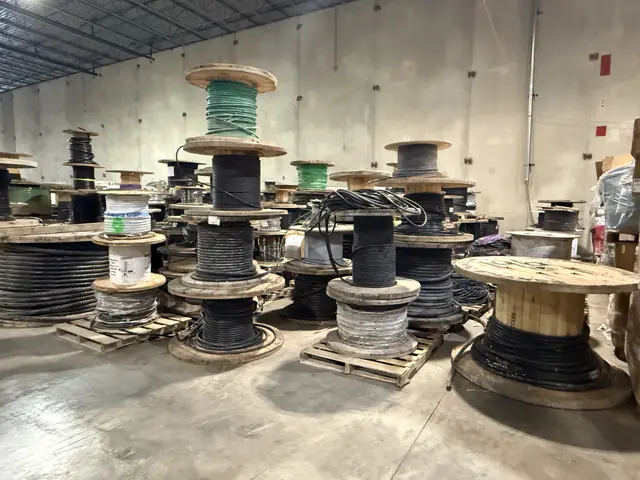
Separate full reels, partial reels, and cut packages
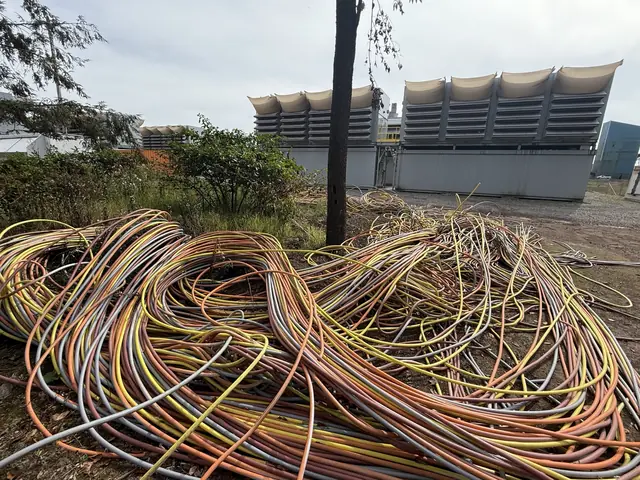
Do not combine unlike reel conditions into one quantity. Record unopened reels, opened full reels, supported partials, coils, and cut lengths separately.
Factory-sealed or unopened reels
Opened reels with original footage records
Partial reels with supported remaining footage
Coils or cuts packaged separately by construction
Support remaining footage with more than an estimate
Use meter or footage marks, reel schedules, original and ending readings, takeoff records, scale or dimensional methods, and clear photographs when available, then connect each reel to its owner and release authority.
Original reel tag and footage
Beginning and ending footage or meter marks
Reel number and project takeoff record
Conductor, gauge, jacket, condition, ownership, release, and cut-end photos
Photograph the complete reel, label, flange, cut end, and footage evidence before moving or altering a partial reel.
Keep partial reels stable and identifiable
Secure loose ends, protect readable labels, chock sound flanges, and keep released reels grouped by record. Handling or pickup is considered only after material, access, written terms, and approval are confirmed.
What makes remaining footage supportable on a partial reel?
Footage or meter marks, reel schedules, takeoff records, original and ending readings, or a documented dimensional or weight method are stronger than an unsupported visual estimate.
Should a partial reel be cut or re-spooled before review?
No. Keep the continuous length, original label, flange, cut end, and packaging intact so the construction, condition, and supported footage remain traceable.
Ready to document the project inventory?
Call or send the released inventory record. Review does not guarantee purchase or logistics. Photos can be emailed to electricalequipmentbuyers@gmail.com. Any purchase or logistics arrangement requires agreed terms.